











Competition between fault roughness and mechanical properties in governing sliding instability
We conducted laboratory shear experiments on granite, shale, sandstone, and gypsum with planar and rough faults. We found that RSF law accounts well the slip instability on planar faults and more pronounced stick-slips with larger friction drops occurred on velocity-weakening faults under lower loading rates and higher normal stresses. On fresh and interlocking faults characterized by strong and brittle asperities, geometry roughness dominates over intrinsic rate-dependent frictional properties in controlling the shear behavior, promoting irregular instabilities on velocity-strengthening shale and velocity-weakening rocks like granite and sandstone. However, after breaking high asperities by multiple shearing, the contacts become more homogeneous in strength but spatially scattered, stabilizing sliding due to insufficient energy accumulation for fast slips. In contrast, in weaker rocks governed by plastic deformation during shear (e.g., gypsum), mechanical properties dominate, enabling stable stick-slips even on rough surfaces.
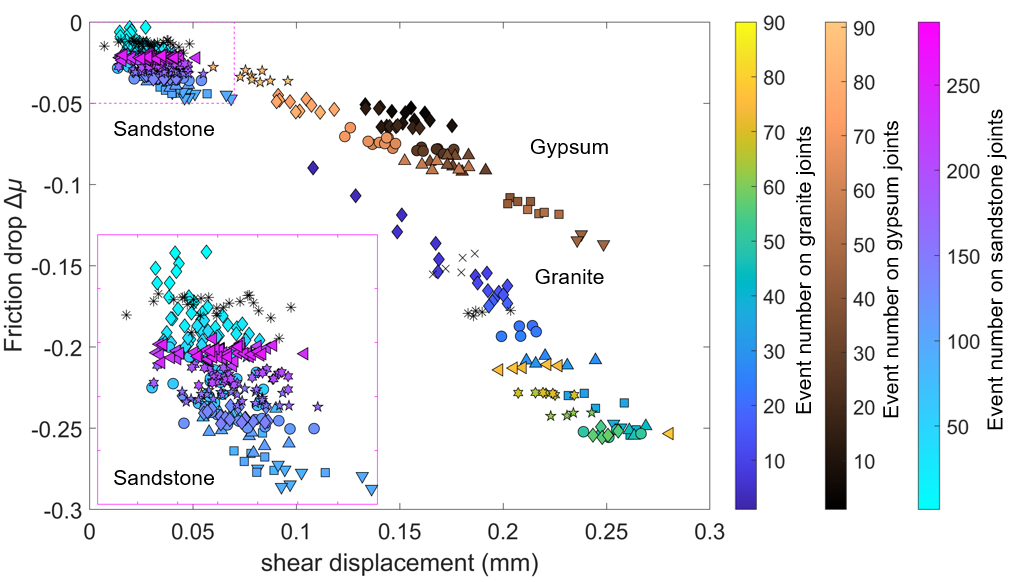
Variations of friction drops as a function shear displacement during the slip phase of stick-slips on planar granite, gypsum, and sandstone faults under normal stress of 2 MPa
Related paper:
- Chai S, Zhao Q (2026). Interplay between fault geometric roughness and mechanical properties in governing sliding instability. To be submitted to Earth and Planetary Science Letters.