












New paper on stress heterogeneity on laboratory faults: Review
New paper in RMRE. Review on the role of stress heterogeneity in seismic slip through laboratory tests.
Chai S, Zou Y, Wu H, Akbariforouz M, Su B, Grasselli G, Elsworth D, Hatzor YH, Zhao Q (2026) The role of stress heterogeneity in seismic slip revealed through experiments on laboratory faults. Rock Mechanics and Rock Engineering https://doi.org/10.1007/s00603-026-05663-0. (Link).
Abstract
Heterogeneous stresses are present on faults at all scales, from field to laboratory, and influence both rupture process and earthquake sequences. As a fundamental and powerful approach, shear experiments on laboratory faults are applied as a surrogate to explore mechanisms during seismic slip, where the respective roles of evolving rheology, deformability, pore fluid pressures, and other influencing parameters may be deconvolved. We present a comprehensive review to explore the shear behavior obtained in ten commonly used laboratory shear configurations and highlight the significance of stress heterogeneity across the interface during shear. After introducing the various laboratory methods, we summarize shear attributes associated with stress heterogeneity, focusing on the rupture process, slip-weakening, stick–slip oscillations and fault roughness, and discuss their possible influence on mechanical and hydraulic behaviors. Laboratory results demonstrate feedback between stress heterogeneity and the resulting shear behavior as controlled by distinct physical attributes of the laboratory faults, significantly enhancing our understanding of the earthquake mechanism. A quantitative assessment of fault length, normal stress, applied shear velocity, and terminal shear displacement across various laboratory shear test configurations identifies their influence and provides guidance for the selection of experimental configurations and conditions to address specific scientific questions. There are still open questions to provide even tighter constraints on stress heterogeneity under experimental conditions, including methods for the dynamic visualization of stress distribution, effects of multi-scale fault roughness, scale effects in laboratory experiments, and the potential application of artificial intelligence to probe response.
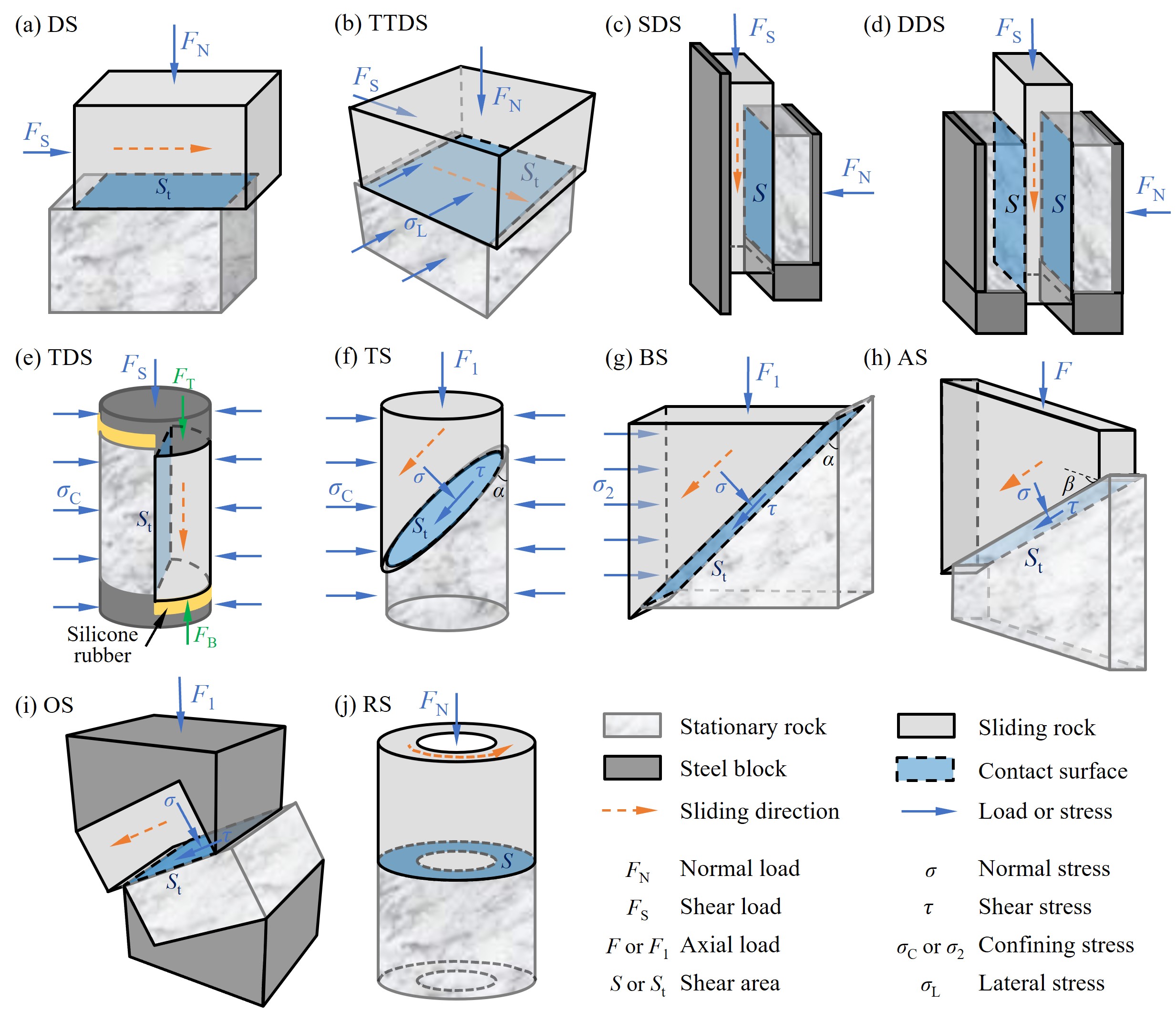
10 laboratory shear configurations